
Table Tennis API for Live Scores, Rankings, Statistics and Real-Time Data
Build table tennis apps, scoreboards, analytics platforms, media products, prediction tools and commercial sports experiences with structured access to fixtures, results, point-by-point scores, rankings, players, tournaments, statistics, head-to-head records and historical match data.
{
  "match_id": "match_tt_48291",
  "status": "live",
  "best_of": 7,
  "sets": {
    "player_a": 2,
    "player_b": 1
  },
  "current_set": {
    "number": 4,
    "player_a": 8,
    "player_b": 6
  },
  "last_event": "point_won"
}
Everything Developers Need From a Table Tennis API
Table Tennis API gives applications structured access to table tennis data without forcing developers to assemble fixtures, rankings, player profiles, match results and live scores from disconnected sources.
Use focused endpoints to build live-score applications, tournament trackers, ranking dashboards, broadcaster tools, fantasy products, betting interfaces, prediction models, research platforms and federation-style data products.
Unlike a fan-oriented sports website, the platform is designed around developer workflows: stable identifiers, machine-readable responses, documented filters, historical context, coverage discovery and real-time integration options.
Table Tennis Data Available Through the API
Live Scores
Retrieve current match state, set scores, point scores, server status and supported live events.
Point-by-Point Scoring
Build live timelines using supported point-won events, set changes and match progression.
Fixtures
Access upcoming matches by tournament, date, player, stage or competition where supported.
Results
Retrieve final scores, set history, walkovers, retirements and completed match status.
Player Rankings
Access current ranking position, ranking points, movement and historical ranking records where available.
Player Profiles
Retrieve player identities, nationality, ranking context, results and supported career statistics.
Tournament Schedules
Build calendars, round pages and tournament trackers using structured schedule data.
Player Statistics
Analyse wins, losses, current form, set win rate, match win rate, streaks and tournament performance.
Head-to-Head
Compare previous meetings, recent matches, set history, ranking differences and matchup trends.
Historical Results
Retrieve previous matches, tournaments, ranking history and long-term player performance according to available depth.
Live Odds
Access supported pre-match or live betting markets where odds coverage is included in the selected plan.
Predictions
Use supported win probabilities, player-strength signals and forecast outputs where prediction data is available.
REST API
Retrieve complete match state, rankings, schedules, players, statistics and historical data through HTTPS endpoints.
WebSocket
Stream supported live events such as point won, set won, match started and match completed.
Developer Documentation
Integrate using endpoint references, JSON examples, filtering, errors and production guidance.
Table Tennis Data for Real Products
Use the same structured data layer across consumer apps, media products, analytics systems and internal tools.
| Product | Core data requirements | Recommended API features Integration focus |
|---|---|---|
| Live Score AppWeb or mobile | Fixtures, point scores, set scores, match status and results | Live Scores API + WebSocket |
| Tournament TrackerSchedules and rounds | Tournaments, fixtures, draws, rounds, players and results | Fixtures + Results + Player Profiles |
| Rankings PlatformCurrent and historical rankings | Ranking position, points, movement, nationality and profiles | Rankings API + Historical Data |
| Analytics ProductPerformance and comparison | Statistics, current form, H2H, ranking history and results | Statistics + Head-to-Head |
| Betting or Prediction ToolCommercial analysis | Live scores, historical results, rankings, H2H, odds and models | H2H + Statistics + Odds/Predictions where available |
| Broadcaster or Media SiteLive and editorial products | Live score, player profile, ranking, tournament and statistics | Live Scores + Rankings + Statistics |
Build Live Table Tennis Scoreboards
Table tennis scoring has more detail than a simple match winner. A useful live application needs to understand the current set, point score, completed sets, server changes and match-ending conditions.
Current Point Score
Show the current score inside the active set and update it as supported point events arrive.
Set Score
Display completed sets and the number of sets won by each player.
Match Status
Distinguish scheduled, live, completed, walkover, retirement and other supported states.
Server Status
Display the serving player where live feed coverage includes this field.
Walkovers
Represent matches decided without normal competitive completion.
Retirements
Preserve the score and match state when a player retires from a match.
Table Tennis Rankings Built Into the Data Model
Rankings are central to table tennis applications. Use ranking data to build player pages, tournament previews, seed comparisons, historical dashboards and prediction features.
Current Ranking
Retrieve the latest supported ranking position and points.
Ranking History
Track how a player’s position changes over weeks, months and seasons where historical rankings are available.
Ranking Movement
Show positions gained or lost between supported ranking releases.
Nationality
Connect ranking records to player nationality and profile context.
Player Profiles
Combine ranking information with identity, results and statistics.
Ranking Comparison
Compare two players directly in head-to-head and prediction workflows.
Table Tennis Statistics for Players, Matches and Tournaments
Use statistical endpoints to compare players, monitor form and build deeper analytical products.
Career Wins and Losses
Analyse overall supported match records across competitions and seasons.
Current Form
Build recent-match summaries using wins, losses, sets and opponent context.
Set Win Percentage
Compare the proportion of supported sets won and lost.
Match Win Percentage
Measure success across selected tournaments, date ranges or career history.
Win Streaks
Track consecutive supported wins and changes in recent form.
Tournament Performance
Compare results, stages reached and opponents across events.
Average Match Duration
Analyse match length where start and completion timing is available.
Head-to-Head Record
Include previous meetings as part of broader player analysis.
Compare Any Two Players With Head-to-Head Data
Head-to-head data helps developers create matchup pages, prediction inputs, betting analysis and tournament previews.
Previous Meetings
Retrieve supported historical matches played between two players.
Win/Loss Record
Summarise how often each player won within the selected sample.
Recent Meetings
Focus on the latest direct matchups rather than only all-time history.
Set History
Compare sets won and lost across previous meetings.
Tournament History
Identify where previous matchups took place and at which stage.
Ranking and Form Comparison
Combine direct history with current ranking and recent results.
Build Around the Table Tennis Competitions Your Product Needs
The final coverage matrix should identify supported tours, championships, international events, domestic competitions and historical seasons individually.
Competition groups that developers commonly need to evaluate include WTT events, ITTF-sanctioned competition data, Olympic table tennis, World Championships and other international or domestic tournaments. Exact coverage must be confirmed before publication.
WTT Events
Confirm fixtures, live scores, draws, rankings and statistics event by event.
ITTF Competition Data
Confirm the exact tournaments, ranking resources and historical seasons included.
Olympic Table Tennis
Confirm qualification, draw, schedule, result and live-data coverage for the required edition.
World Championships
Verify event-level fixtures, results, players and historical coverage.
Domestic Competitions
Check country, league, tournament and season availability individually.
Historical Tournaments
Confirm how far back results, rankings and player statistics extend.
Choose the Right Delivery Method
REST provides complete state and historical resources. WebSocket is designed for incremental live events.
| Requirement | REST API | Real-time delivery WebSocket |
|---|---|---|
| Fixtures and schedulesUpcoming matches | Recommended | Usually unnecessary |
| Initial match stateScore and completed sets | Recommended | Subscribe after loading state |
| Point wonIncremental live event | Requires polling | Push event where supported |
| Set wonLive match progression | Requires polling | Push event where supported |
| Rankings and historyReference data | Recommended | Not required |
| RecoveryAfter network interruption | Reload authoritative state | Reconnect and resubscribe |
Make Your First Table Tennis API Request
The examples below use placeholder endpoints and authentication. Replace them with the final production documentation.
Live Matches Endpoint
GET https://api.example.com/v1/table-tennis/matches/live

Authorization: Bearer YOUR_API_KEY
Accept: application/json
JavaScript
const response = await fetch(
  'https://api.example.com/v1/table-tennis/matches/live',
  {
    headers: {
      'Authorization': 'Bearer YOUR_API_KEY',
      'Accept': 'application/json'
    }
  }
);

if (!response.ok) {
  throw new Error(`API error: ${response.status}`);
}

const data = await response.json();
Python
import requests

response = requests.get(
    "https://api.example.com/v1/table-tennis/matches/live",
    headers={
        "Authorization": "Bearer YOUR_API_KEY",
        "Accept": "application/json",
    },
    timeout=15,
)

response.raise_for_status()
data = response.json()
PHP
<?php

$url = 'https://api.example.com/v1/table-tennis/matches/live';

$ch = curl_init($url);

curl_setopt_array($ch, [
    CURLOPT_RETURNTRANSFER => true,
    CURLOPT_HTTPHEADER => [
        'Authorization: Bearer YOUR_API_KEY',
        'Accept: application/json',
    ],
    CURLOPT_TIMEOUT => 15,
]);

$body = curl_exec($ch);
$status = curl_getinfo($ch, CURLINFO_HTTP_CODE);

curl_close($ch);
Example Live Table Tennis Match JSON
{
  "data": {
    "match_id": "match_tt_48291",
    "tournament": {
      "id": "tournament_211",
      "name": "Example International Open"
    },
    "status": "live",
    "round": "quarterfinal",
    "best_of": 7,
    "player_a": {
      "id": "player_tt_101",
      "name": "Player A",
      "ranking": 8
    },
    "player_b": {
      "id": "player_tt_204",
      "name": "Player B",
      "ranking": 14
    },
    "sets": {
      "player_a": 2,
      "player_b": 1
    },
    "set_history": [
      {"set": 1, "player_a": 11, "player_b": 7},
      {"set": 2, "player_a": 9, "player_b": 11},
      {"set": 3, "player_a": 11, "player_b": 6}
    ],
    "current_set": {
      "number": 4,
      "player_a": 8,
      "player_b": 6
    },
    "last_event": {
      "event_id": "event_tt_90018",
      "type": "point_won",
      "player_id": "player_tt_101"
    },
    "updated_at": "2026-08-07T05:20:12Z"
  }
}
Final response fields must follow the published production documentation.
Stream Table Tennis Events With WebSocket
A real-time stream can remove polling delay for applications that need point-by-point updates during a match.
Illustrative Subscription
{
  "action": "subscribe",
  "channel": "table_tennis_match_events",
  "match_ids": [
    "match_tt_48291"
  ]
}
Illustrative Point Event
{
  "event_id": "event_tt_90018",
  "match_id": "match_tt_48291",
  "type": "point_won",
  "sequence": 73,
  "set_number": 4,
  "player_id": "player_tt_101",
  "score": {
    "player_a": 8,
    "player_b": 6
  },
  "created_at": "2026-08-07T05:20:12Z"
}
Possible Live Event Types
- match_started
- point_won
- set_won
- match_completed
- walkover
- retirement
- match_status_changed
- tournament_updated
Built Specifically for Table Tennis Data Workflows
Table Tennis First
The data model is designed around sets, points, rankings, tournaments and player matchups rather than generic sports fields.
Stable Identifiers
Connect players, matches, tournaments, ranking records and events through consistent IDs.
Developer-Friendly JSON
Use structured responses rather than scraping rendered scoreboard pages.
Historical Context
Combine current matches with previous results, ranking history, statistics and H2H records.
REST + Real-Time Options
Use REST for complete state and WebSocket for supported incremental live events.
Coverage Discovery
Confirm tournaments, seasons and feature availability before building production dependencies.
Why Use a Table Tennis API Instead of Scraping Score Websites?
| Requirement | Structured API | Scraping rendered pages |
|---|---|---|
| Data structure | Documented JSON fields | Dependent on page markup |
| Stable identities | Player, match and tournament IDs | Often inferred from text or URLs |
| Live updates | REST or event delivery where supported | Repeated page fetching and parsing |
| Error handling | Documented HTTP and API errors | Markup changes can silently break extraction |
| Historical queries | Filterable endpoints | Requires crawling many pages |
| Production maintenance | Versioned integration | Parser updates after website changes |
Data access and commercial rights still depend on the provider’s licence and plan, but a documented API offers a cleaner technical contract than scraping presentation-layer HTML.
Choose a Table Tennis API Plan That Matches Your Product
Pricing should scale according to request capacity, competition coverage, historical depth and advanced products such as odds, predictions or WebSocket access.
Prototype
Test authentication, endpoint structure and basic table tennis data.
Developer
Build a focused live-score, ranking or tournament application.
Commercial
Add broader coverage, statistics, history and higher request capacity.
Enterprise
Create custom coverage, limits, licensing and support for high-volume products.
Documentation, SDKs and Integration Examples
Production documentation should explain authentication, endpoints, pagination, filtering, error handling, rate limits, WebSocket recovery and coverage discovery.
API Reference
Review endpoint paths, parameters, schemas and response fields.
Code Examples
Start with JavaScript, Python and PHP integration patterns.
SDKs
Use officially supported SDKs where available, or call the REST API directly through standard HTTP clients.
Error Reference
Handle authentication, validation, limits and temporary service errors consistently.
Coverage Reference
Check tournaments, seasons and data-category availability.
WebSocket Guide
Implement authentication, subscriptions, heartbeats and safe reconnection.
Learn to Build With Table Tennis Data
Practical tutorials for developers creating live-score, ranking, analytics, prediction and commercial table tennis products.
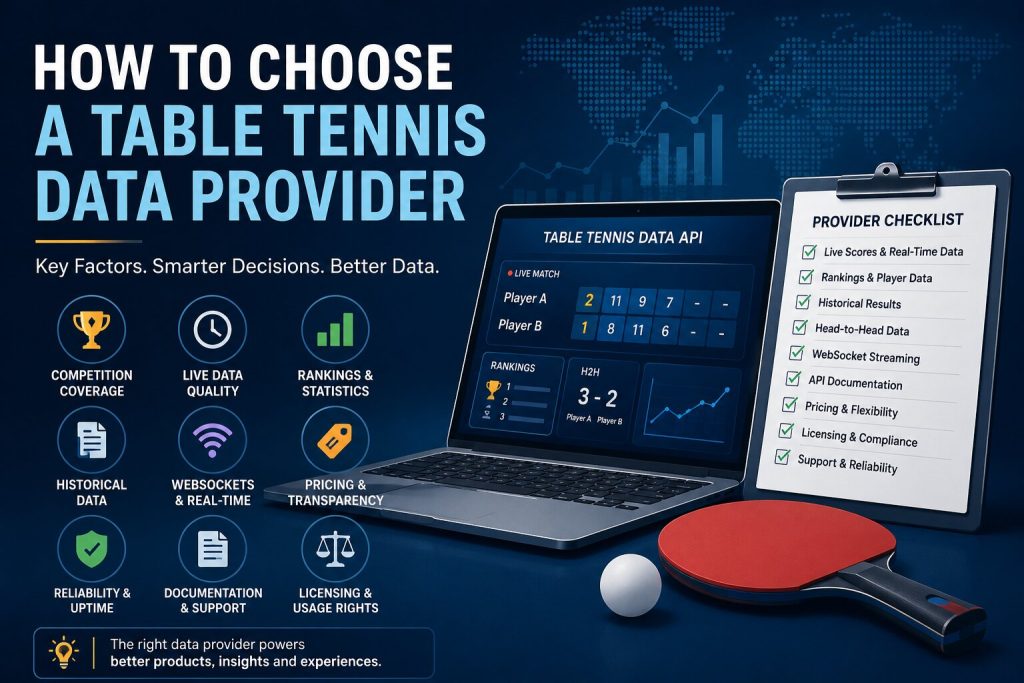
How to Choose a Table Tennis Data Provider
Learn how to evaluate a Table Tennis data provider across competition coverage, live-score depth, historical data, rankings, H2H, WebSockets, documentation, pricing, licensing and production…
Read Guide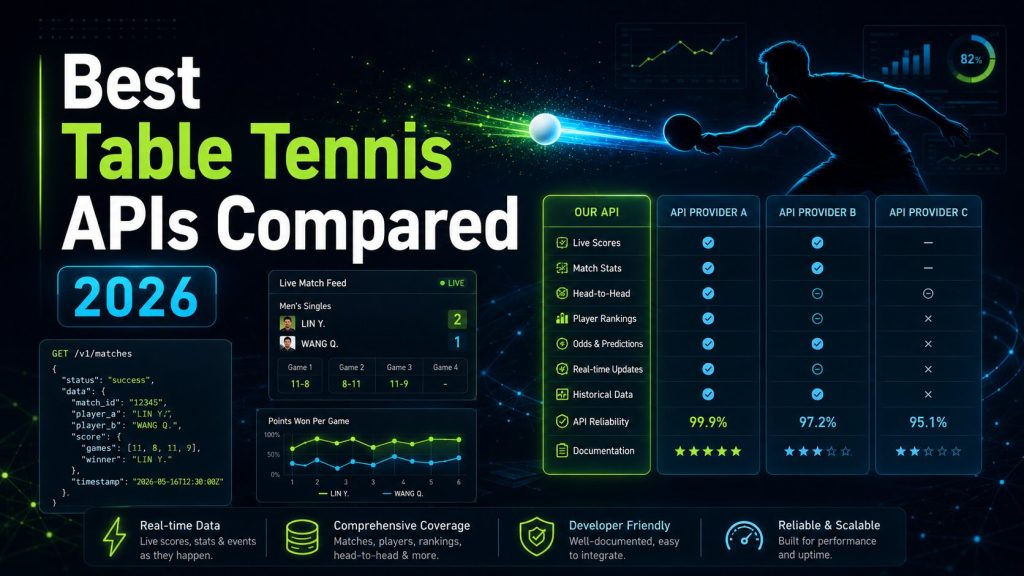
Best Table Tennis APIs Compared (2026)
Compare leading Table Tennis API providers in 2026 across live scores, rankings, statistics, historical data, real-time delivery, pricing transparency and developer tooling.
Read Guide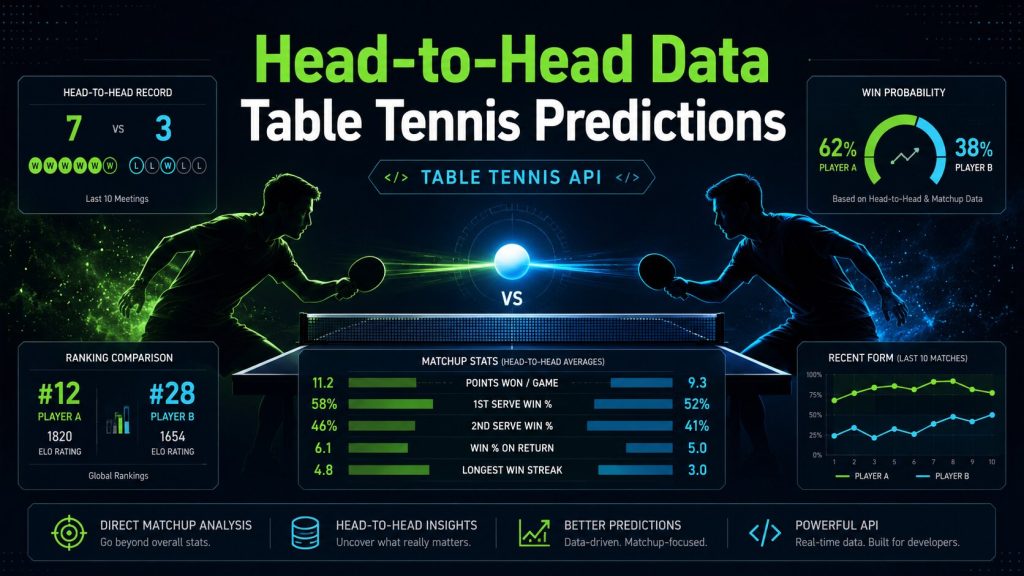
How Head-to-Head Data Improves Table Tennis Predictions
Learn how previous meetings, set history, ranking differences, recent form and Elo-style ratings can be transformed into useful table tennis prediction features while avoiding…
Read Guide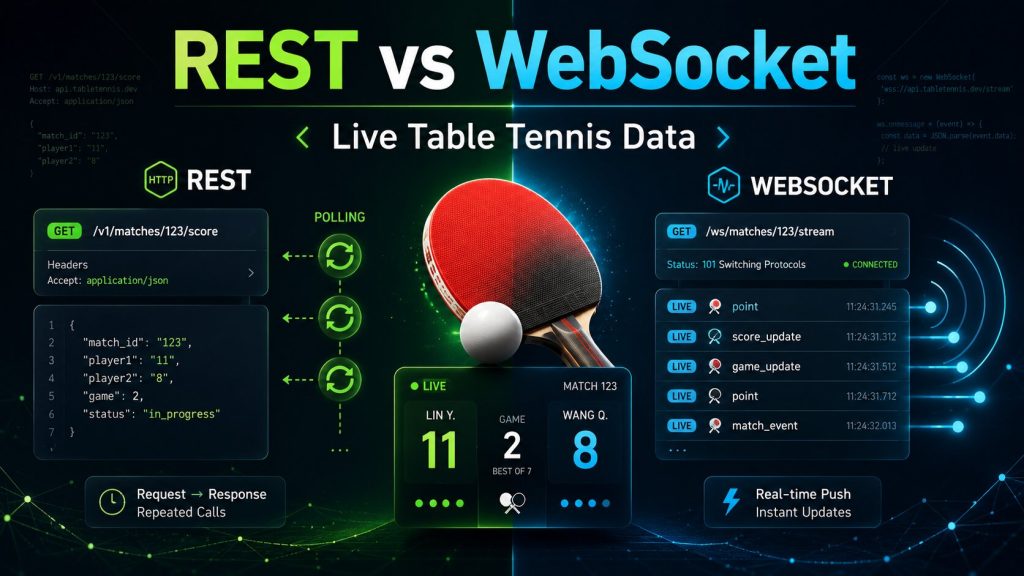
REST vs WebSocket APIs for Live Table Tennis Data
Compare REST and WebSocket APIs for live table tennis data, including polling, push updates, latency, bandwidth, scalability, reconnect recovery and the best hybrid production…
Read Guide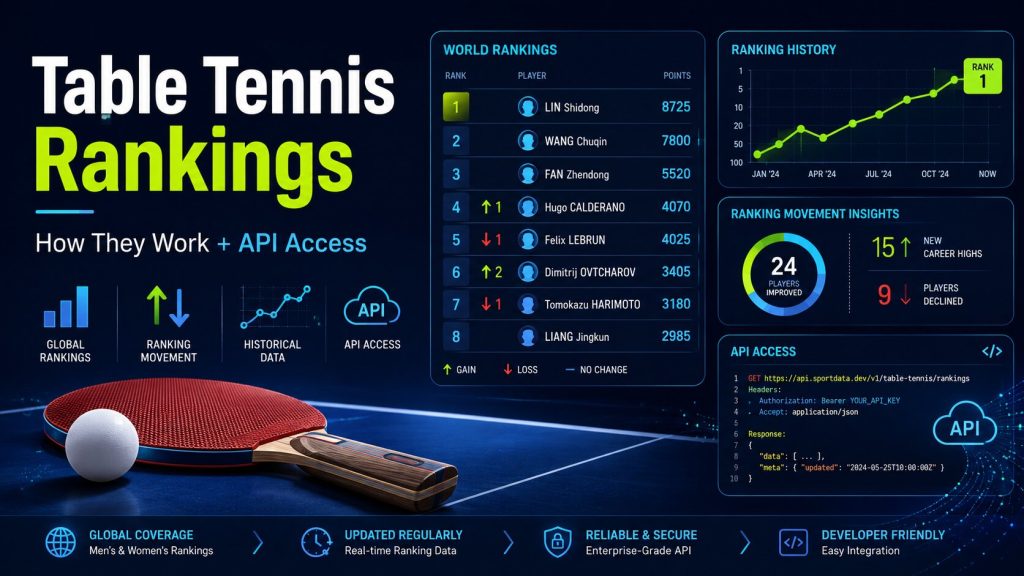
How Table Tennis Rankings Work (And How to Access Them via API)
Understand how table tennis world rankings, ranking points and movement work, including important 2026 changes, then learn how to retrieve and store current and…
Read Guide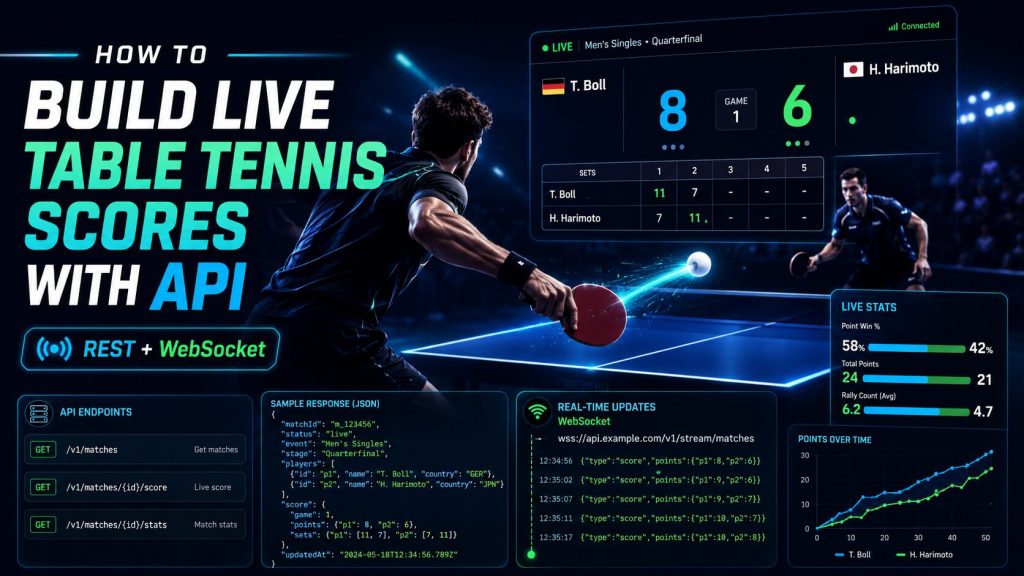
How to Build a Live Table Tennis Scores App Using a Table Tennis API
Learn how to build a live table tennis scores application with fixtures, current point scores, completed sets, REST polling, WebSocket events, caching, reconnect recovery…
Read GuideTable Tennis API FAQs
What data does the Table Tennis API provide?
Depending on coverage, the API can provide fixtures, live scores, set scores, point-by-point events, results, rankings, players, tournaments, statistics, H2H records and historical data.
Does the API include live point-by-point scoring?
Point-by-point events may be available for supported matches and plans. Confirm tournament-level coverage before production.
Can I retrieve player rankings?
Ranking endpoints can expose current ranking position, points, movement and historical ranking data where supported.
Does the API include WTT and ITTF data?
The final coverage matrix should confirm individual WTT, ITTF and other tournament resources rather than relying on a generic claim.
Can I build a prediction model with the API?
Historical results, rankings, statistics and H2H data can support model development where sufficient coverage and licensing are available.
Does the API support WebSocket?
WebSocket access can stream supported live events such as points, sets and match-status changes where included.
Are live odds available?
Odds may be available for selected tournaments and plans. Confirm bookmaker and market coverage separately.
How is the API different from scraping?
A structured API provides documented fields, stable identifiers, filtering and error handling instead of depending on rendered page markup.
How far back does historical data go?
Historical depth varies by tournament and data category. Confirm the required seasons before launching.
Build Your Table Tennis Product With One Developer API
Confirm the tournaments, rankings, live events, statistics and historical data your product needs, then choose the API plan that fits your integration.