
How to Choose a Table Tennis Data Provider
Learn how to evaluate a Table Tennis data provider across competition coverage, live-score depth, historical data, rankings, H2H, WebSockets, documentation, pricing, licensing and production reliability.
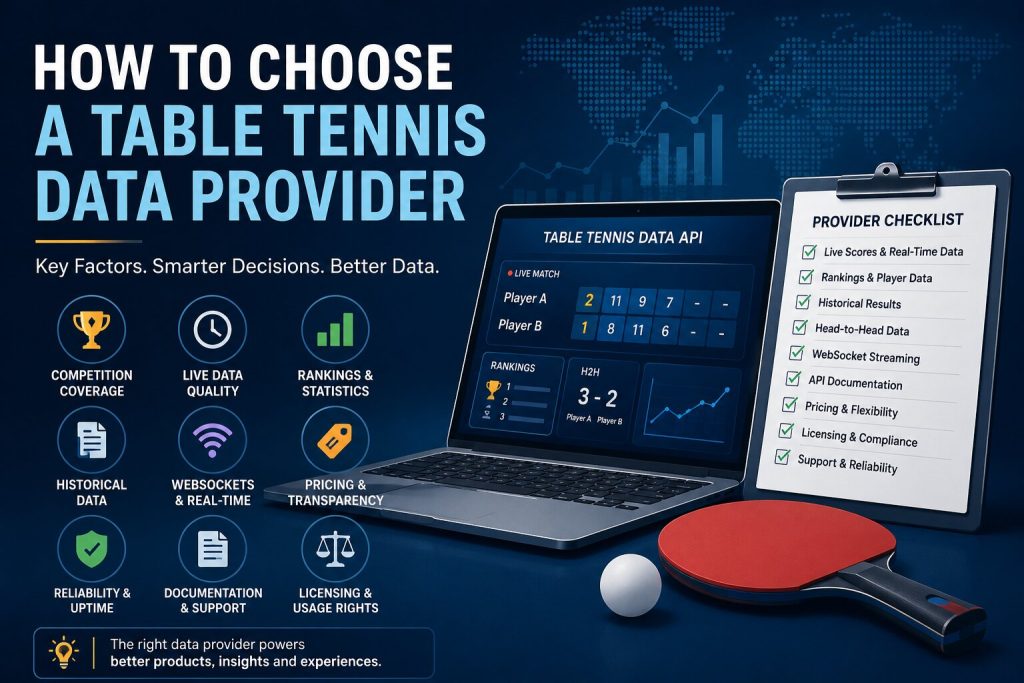
How to Choose a Table Tennis Data Provider
Evaluate competition coverage, data accuracy, live-score depth, historical data, rankings, statistics, WebSocket delivery, documentation, pricing, licensing and support before committing your product to a Table Tennis API provider.
Choosing a table tennis data provider is not only a technical decision. Once your application depends on one feed for fixtures, live scores, rankings or historical results, that provider becomes part of your product infrastructure.
A provider can have an attractive homepage and still be the wrong fit if it misses the competitions you need, has shallow historical coverage, offers live scores without point-level events or restricts the way you can store and redistribute data.
This guide gives you a practical evaluation framework so you can compare providers based on the actual requirements of your product.
1. Start With Your Product, Not the Provider
Before comparing vendors, write down exactly what you are building. Different table tennis products need very different data.
Live scores app
Needs fixtures, active match state, set scores and possibly point-level events.
Ranking website
Needs current rankings, historical ranking snapshots and stable player identities.
Analytics platform
Needs deep historical results, statistics, H2H and consistent IDs.
Prediction model
Needs leakage-safe historical data, rankings, form and matchup context.
Broadcast product
Needs reliable live state, player context, rankings and display rights.
Betting product
May also need licensed pre-match/live odds and market-level data.
A provider that is excellent for live scores may be a poor choice for historical modelling, and the reverse can also be true.
2. Create a Must-Have Requirements List
Separate essential requirements from features that would simply be nice to have.
| Requirement | Priority | Example decision |
|---|---|---|
| Target competitions | Must have | Reject a provider that misses a core tournament. |
| Live point events | Must have for point-by-point app | Set-level live scores alone are not enough. |
| Ranking history | Must have for ranking analytics | Current rankings alone do not satisfy the requirement. |
| WebSocket | Product dependent | May be optional for a results archive. |
| Odds | Product dependent | Not needed for a non-betting application. |
| SDK | Nice to have | Good documentation may matter more. |
3. Verify Competition Coverage One Competition at a Time
“Global table tennis coverage” is too vague for a production decision. Ask the provider for the exact competition IDs or coverage matrix.
- Target WTT competitions
- Target ITTF-related events
- Olympic table tennis where required
- World Championships where required
- Domestic leagues
- National championships
- Regional competitions
- Historical editions of those competitions
4. Check Feature Coverage Inside Each Competition
| Feature | Question to ask |
|---|---|
| Fixtures | Are all scheduled matches and rounds included? |
| Results | Are final set-by-set scores available? |
| Live scores | Is the active set and current point score available? |
| Point-by-point | Are individual points exposed as events? |
| Statistics | Which player and match metrics are included? |
| Rankings | Which ranking sources and categories are supported? |
| H2H | How many previous meetings are available? |
| Historical data | How far back does coverage extend? |
| WebSocket | Does live streaming cover this exact competition? |
5. “Live Scores” Can Mean Several Different Things
Two providers can both advertise live scores while offering very different products.
Match-level live
Only current match status and total sets won.
Set-level live
Includes the current set and current point score.
Point-level events
Every supported point arrives as an event or timeline item.
Event metadata
May include sequence IDs, timestamps, server or exceptional states.
A point-by-point application should not sign a contract based only on the phrase “real-time scores.”
6. Test Update Freshness Instead of Trusting a Headline Number
If live speed matters, measure the complete data path during a trial.
provider_event_time
your_backend_received_time
your_backend_processed_time
frontend_received_time
frontend_rendered_time
end_to_end_freshness =
frontend_rendered_time - provider_event_time
Test several competitions and busy match periods. A single successful request is not enough to evaluate a production feed.
7. Evaluate Data Accuracy and Identity Consistency
Fast data is not useful if player IDs change unexpectedly, duplicate fixtures appear or final scores need manual correction.
- Check stable player IDs across competitions
- Check stable tournament and competition IDs
- Check duplicate fixture behaviour
- Check name consistency and aliases
- Check walkovers and retirements
- Check postponed or cancelled matches
- Check set-by-set final results
- Check whether corrected results propagate cleanly
8. Ask How Corrections Are Handled
Sports data can be corrected after publication. Your application needs to know whether the provider updates the same record, publishes a revision or expects clients to rediscover the correction later.
Questions to ask
Does the match ID stay the same after a correction?
Is there an updated timestamp?
Can WebSocket clients receive corrected events?
How should historical caches be invalidated?
9. Historical Depth Can Make or Break an Analytics Product
A provider can be excellent at live scores and still be unsuitable for modelling or H2H analytics if its archive is shallow.
| Historical resource | What to verify |
|---|---|
| Match results | Earliest supported date or season by competition. |
| Set scores | Whether old matches preserve set-level results. |
| Point events | Whether historical point-by-point timelines exist. |
| Rankings | How many historical ranking releases are stored. |
| Statistics | Which metrics exist historically and from what date. |
| H2H | Whether direct meeting history is complete for your target period. |
10. Do Not Accept “Full History” Without a Date
Ask the provider to state historical depth as a real boundary: competition X from season Y, or data category Z from a specific date.
“Historical data available” is marketing language. “Set-by-set results available from 2021 for competition X” is implementation information.
11. Verify Rankings as a Separate Data Product
Ranking coverage is central to table tennis, so ask specific questions.
- Which ranking source is represented?
- Which ranking categories are supported?
- Are ranking points included?
- Is previous position included?
- Are historical ranking snapshots available?
- Are stable player IDs connected to ranking records?
- How quickly are new ranking releases published?
12. Evaluate Head-to-Head Depth
H2H is only as useful as the archive behind it.
Meeting count
How many supported historical meetings exist?
Set history
Are individual historical set scores preserved?
Dates
Can you distinguish recent meetings from old ones?
Ranking context
Can historical meetings be joined to historical rankings?
13. Statistics Need Clear Definitions
A field called win_percentage is not useful unless you know which competitions, dates and match types contribute to it.
| Metric | Definition question |
|---|---|
| Match win % | Which supported matches are included? |
| Set win % | Does the archive include all required set scores? |
| Recent form | How many matches define “recent”? |
| Win streak | Across which competitions? |
| Tournament performance | How are rounds and editions normalised? |
14. Decide Whether REST Is Enough
REST is usually the simplest integration model and is well suited to fixtures, results, rankings, statistics and historical queries.
REST advantages
Simple debugging, caching, retries and authoritative state queries.
REST limitation
Live updates require polling if no push interface exists.
For a simple results or ranking application, WebSocket may add complexity without adding value.
15. Verify What the Provider Means by WebSocket
A provider can advertise WebSocket while streaming only selected data types.
- Does WebSocket stream live scores?
- Does it include point-by-point events?
- Does it include odds only?
- Can you subscribe by match?
- Can you subscribe by tournament?
- Are sequence IDs available?
- Is missed-event replay supported?
- How many concurrent connections are allowed?
- How many subscriptions are allowed?
16. Ask About Recovery Behaviour
A live system must survive temporary disconnections.
17. Documentation Quality Predicts Integration Cost
Poor documentation does not only slow the first integration. It increases debugging cost every time you encounter an edge case.
- Authentication examples
- Endpoint reference
- Request parameters
- Response schemas
- Error codes
- Rate-limit documentation
- Pagination model
- WebSocket event schemas
- Versioning policy
- Deprecation policy
- Code examples
- Changelog
18. Test the Developer Experience During the Trial
Use the free trial or evaluation period like a production rehearsal.
| Test | What you learn |
|---|---|
| First authenticated request | How easy onboarding really is. |
| Find one target competition | How discoverable the coverage model is. |
| Load live matches | Whether live schemas are practical. |
| Handle a 429 | Whether rate-limit behaviour is documented. |
| Reconnect WebSocket | Whether recovery is understandable. |
| Ask support one technical question | How responsive and knowledgeable support is. |
19. Calculate Real Monthly Cost, Not Just Plan Price
The cheapest listed plan may not support your required traffic, competitions or data rights.
monthly_requests =
active_matches
× refreshes_per_match
× active_days
× endpoint_calls_per_refresh
Also include these costs
- Higher request tiers
- WebSocket add-ons
- Historical-data add-ons
- Odds or prediction add-ons
- Commercial display rights
- Redistribution rights
- Support or SLA upgrades
- Engineering time caused by poor tooling
20. Understand the Difference Between Quota and Rate Limit
| Limit | Meaning |
|---|---|
| Monthly quota | Total requests available during the billing period. |
| Per-minute limit | How quickly requests may be sent. |
| Concurrent connections | How many WebSockets may remain open. |
| Active subscriptions | How many live matches or channels may be followed. |
| Bulk export limit | Restrictions on large historical downloads. |
21. Read the Licensing Terms Before You Build Around the Feed
Technical access does not automatically grant every commercial right.
| Use case | Question to confirm |
|---|---|
| Internal analytics | Can data be stored and analysed internally? |
| Public website | Can scores and rankings be displayed publicly? |
| Mobile app | Can data be distributed to application users? |
| Broadcast product | Are media/broadcast display rights included? |
| Derived analytics | Can you store data to create derived metrics? |
| Redistribution | Can raw data be passed to your customers? |
| Resale | Can API access or the underlying data be resold? |
22. Evaluate SLA and Reliability Terms
Enterprise products should ask for more than a vague “high uptime” promise.
- Contracted availability target
- Severity-based support response times
- Incident notification process
- Planned-maintenance policy
- Status page or incident history
- Service credit terms where applicable
- Escalation process
- Dedicated support contact where needed
23. Evaluate Support Before the Emergency
The best time to test support is during evaluation, not when your live product is already failing.
Send one real technical question during the trial
Ask about a competition ID, live status field, historical boundary or reconnect scenario. Measure how quickly the team responds and whether the answer is technically useful.
24. Look for API Versioning and Change Management
Your integration can break even when the data itself remains available if the provider changes field names or removes endpoints without a clear migration process.
- Versioned API routes or schemas
- Deprecation notice periods
- Changelog
- Backward-compatible field additions
- WebSocket schema versioning
- Migration documentation
25. Build a Provider Scorecard
A weighted scorecard helps teams avoid choosing a provider based on one impressive demo.
| Category | Example weight |
|---|---|
| Target competition coverage | 25% |
| Live-data depth and freshness | 20% |
| Historical depth | 15% |
| Rankings / stats / H2H | 10% |
| Documentation and tooling | 10% |
| Reliability and support | 10% |
| Pricing and licensing | 10% |
26. Run a Real Trial Across Your Target Matches
27. Red Flags to Watch For
No coverage matrix
The provider cannot clearly say which competitions support which features.
No historical boundary
“Historical data” is offered without dates or depth.
No stable IDs
Your database may become dependent on changing display names.
No rate-limit guidance
You cannot safely design traffic or caching behaviour.
No versioning policy
Breaking changes may become an operational risk.
Unclear rights
Technical access exists but public display or redistribution is ambiguous.
28. Final Evaluation Checklist
- Exact competition list verified
- Fixtures and result coverage verified
- Live set-level depth verified
- Point-by-point availability verified
- Exceptional match states verified
- Historical depth documented
- Ranking source and categories documented
- H2H depth checked
- Statistics definitions understood
- REST limits understood
- WebSocket scope and limits understood
- Recovery behaviour tested
- Documentation quality reviewed
- Support response tested
- Real monthly cost calculated
- Display/storage/redistribution rights confirmed
- SLA requirements confirmed
- Versioning and deprecation process reviewed
Frequently Asked Questions
What is the most important factor when choosing a Table Tennis API?
Exact coverage of the competitions and data features your product requires. A technically impressive API is not useful if it misses your core events.
Should I choose the provider with the lowest price?
Not automatically. Missing data, poor documentation or restrictive licensing can create greater total cost than a higher subscription.
Do I need WebSocket?
Only if your product benefits from pushed live events. Fixtures, results, rankings and historical data work naturally through REST.
How important is historical data?
It is critical for H2H analysis, statistics, ranking trends and prediction models, but less important for a simple live-score widget.
How do I compare provider speed?
Test the same live matches and measure provider-event-to-screen freshness rather than relying only on HTTP response time.
Should rankings and H2H be evaluated separately?
Yes. They depend on different source data and historical depth and should not be assumed from generic “statistics” coverage.
Can I switch providers later?
Yes, but migration is much easier if your application uses an internal normalised schema rather than exposing provider-specific field names throughout your codebase.
Choose the Provider That Fits Your Product, Not the Best Marketing Page
Verify competition coverage, live depth, history, rankings, delivery methods, pricing and licensing against your real production requirements before committing.
Build Cricket Products With Reliable API Data
Access live scores, fixtures, ball-by-ball updates, statistics, odds, predictions and historical cricket data through one developer-friendly API.
Get API Access