
REST vs WebSocket APIs for Live Table Tennis Data
Compare REST and WebSocket APIs for live table tennis data, including polling, push updates, latency, bandwidth, scalability, reconnect recovery and the best hybrid production architecture.
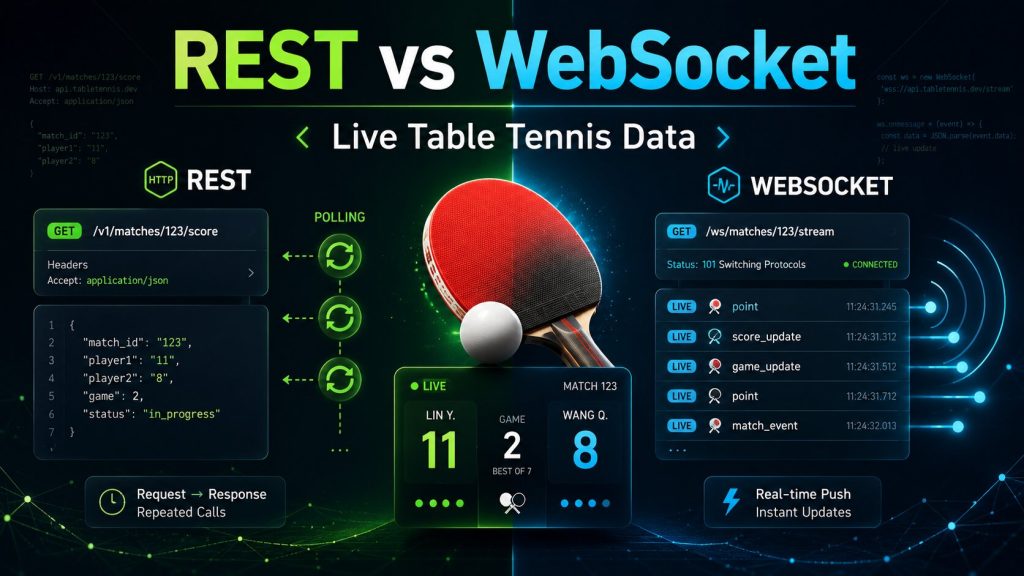
REST vs WebSocket APIs for Live Table Tennis Data
Compare REST polling and WebSocket streaming for live table tennis scores, point-by-point events, set updates, bandwidth, latency, scalability, reliability and production architecture.
REST and WebSocket are often presented as competing technologies, but in a live sports application they usually solve different parts of the same problem.
REST is excellent when your application needs a complete answer: fixtures, current match state, results, rankings, statistics or historical records. WebSocket is excellent when your application needs to know what changed: a point was won, a set ended, a match started or a final result was confirmed.
Table tennis makes this distinction especially useful because live matches can generate frequent small score changes. The architecture that works for a prototype may become wasteful or unreliable once thousands of users are following the same matches.
1. REST vs WebSocket at a Glance
| Requirement | REST API | WebSocket API |
|---|---|---|
| Connection model | Independent request and response. | Persistent connection. |
| Live update discovery | Client requests the latest state. | Server pushes supported events. |
| Initial match state | Excellent fit. | Usually not enough by itself. |
| Historical queries | Excellent fit. | Not the primary purpose. |
| Point-by-point events | Possible through repeated polling. | Well suited where point events are supported. |
| Implementation complexity | Lower. | Higher because connection state must be managed. |
| Recovery after disconnect | Next request retrieves state. | Reconnect, resubscribe and reconcile state. |
| Best role | Authoritative state and queries. | Incremental live events. |
Think of REST as “What is the match state now?” and WebSocket as “What just changed?”
2. How REST Works for Live Table Tennis
With REST, your application sends a request whenever it wants the newest state.
GET /v1/table-tennis/matches/live
{
  "match_id": "match_tt_48291",
  "status": "live",
  "sets": {
    "player_a": 2,
    "player_b": 1
  },
  "current_set": {
    "number": 4,
    "player_a": 8,
    "player_b": 6
  }
}
If your application wants to know whether the score changes after that response, it sends another request later.
3. REST Polling Is Simple and Predictable
Polling means repeating the same request at a chosen interval.
let timer;

async function loadLiveMatches() {
  const response = await fetch('/api/live-table-tennis');

  if (!response.ok) {
    throw new Error(
      `Live request failed: ${response.status}`
    );
  }

  return response.json();
}

function startPolling() {
  timer = setInterval(() => {
    if (document.visibilityState === 'visible') {
      loadLiveMatches()
        .then(updateUI)
        .catch(console.error);
    }
  }, 15000);
}
Why developers like REST polling
- Simple request/response mental model
- Easy to test with normal HTTP tools
- Easy to retry after temporary failures
- Works naturally with caching
- Good fit for prototypes and MVPs
- Easy to load complete authoritative state
4. The Limitation of Polling Fast-Moving Matches
Table tennis can produce many score changes in a short period. Polling means your application may repeatedly download unchanged state while also missing the exact sequence of events between snapshots.
12:00:00 → GET score → 7-5
12:00:05 → GET score → 7-5
12:00:10 → GET score → 8-6
12:00:15 → GET score → 9-6
12:00:20 → GET score → 9-6
Two requests returned no new information. And although the state changed from 7–5 to 8–6, a state snapshot alone may not tell you the exact event sequence that occurred between those requests.
5. How WebSocket Streaming Works
A WebSocket connection stays open. After your application subscribes to a supported match or tournament, the provider can push events when the live state changes.
{
  "action": "subscribe",
  "channel": "table_tennis_match_events",
  "match_ids": [
    "match_tt_48291"
  ]
}
Then an event can arrive
{
  "event_id": "event_tt_90018",
  "match_id": "match_tt_48291",
  "type": "point_won",
  "sequence": 73,
  "set_number": 4,
  "player_id": "player_tt_101",
  "score": {
    "player_a": 8,
    "player_b": 6
  }
}
The application no longer has to ask whether that point happened. The event itself carries the change.
6. WebSocket Adds More Moving Parts
The trade-off is complexity. A persistent connection introduces concerns that ordinary REST clients do not need to manage continuously.
Connection state
Your application must know whether the stream is healthy.
Heartbeats
Stale connections need explicit detection where supported.
Reconnects
Clients need controlled backoff and resubscription logic.
Duplicate events
Replayed events must not update the score twice.
Sequence gaps
Missed events need a safe reconciliation path.
Fan-out
One upstream stream may need to serve many end users.
7. Which Is Faster for Live Updates?
WebSocket often feels faster because it removes the wait for the next polling interval.
Point happens
    ↓
Wait until next poll
    ↓
Request sent
    ↓
Response received
    ↓
UI updates
Point happens
    ↓
Provider publishes event
    ↓
Event delivered
    ↓
UI updates
That does not mean WebSocket guarantees a specific latency. End-to-end speed still depends on the original data source, provider processing, network transit, your backend and frontend rendering.
8. Measure the Full Data Path
A fast HTTP response can still contain old data. For live sports, the more useful metric is how long it took a real sports event to reach the screen.
provider_event_time
backend_received_time
backend_processed_time
frontend_received_time
frontend_rendered_time
provider_to_backend =
backend_received_time - provider_event_time

backend_processing =
backend_processed_time - backend_received_time

end_to_end =
frontend_rendered_time - provider_event_time
9. Bandwidth: Full State vs Incremental Events
REST polling may repeatedly transfer the same player, tournament, set and match fields even when only one point changed.
match
players
tournament
status
set history
current set
current points
timestamps
...
point_won
match_id
player_id
new score
sequence
Event-driven delivery can reduce repeated unchanged payloads, although the real bandwidth difference depends on event volume, polling frequency and the provider schema.
10. REST and WebSocket Can Have Different Cost Models
API cost is not determined only by bytes transferred. Providers may limit or bill different resources.
| REST resource | WebSocket resource |
|---|---|
| Monthly request quota | Concurrent connections |
| Requests per minute | Active match subscriptions |
| Repeated polling frequency | Event volume |
| Response payload size | Replay or recovery usage |
11. Do Not Let Every Viewer Poll the Provider
Imagine 10,000 users watching the same match. An inefficient architecture allows every browser to create its own upstream polling loop.
10,000 viewers
      ↓
10,000 independent polling loops
      ↓
Provider API
A much stronger model centralises provider access.
10,000 viewers
      ↓
Your application
      ↓
Shared live match state
      ↓
Controlled upstream polling
or
Shared WebSocket ingestion
One controlled upstream update can then serve thousands of viewers.
12. Do Not Open One Provider WebSocket Per Visitor
WebSocket can be implemented badly too. A persistent upstream connection for every visitor can create unnecessary pressure and expose connection details you would rather keep on the backend.
Provider WebSocket
       ↓
Connection Worker
       ↓
Validation + Deduplication
       ↓
Shared Match State
       ↓
Internal Pub/Sub
       ↓
Your WebSocket / SSE
       ↓
Viewers
Why this pattern scales better
- Controls upstream connection count
- Keeps provider credentials on the backend
- Centralises duplicate protection
- Creates one authoritative live state
- Lets many users share the same provider event
- Makes reconnect recovery easier to manage
13. REST Is Naturally Strong at Recovery
Every REST request can return the latest complete state. If your application loses connectivity, the recovery flow is straightforward.
Network restored
      ↓
GET /matches/{match_id}
      ↓
Receive authoritative state
      ↓
Render correct score
That simplicity is one of the biggest reasons REST remains valuable even in a WebSocket-heavy application.
14. WebSocket Needs Explicit Reconnect Logic
Do not assume every event was received while the connection was interrupted.
15. WebSocket Event Handling Must Be Idempotent
A point event can be retried, replayed or delivered again after reconnection. Your system must be able to see the same event twice without applying it twice.
processed_events

event_id        UNIQUE
match_id
sequence
event_type
processed_at
async function processEvent(event) {
  const exists = await eventStore.has(event.event_id);

  if (exists) {
    return;
  }

  await eventStore.save(event);
  await updateMatchState(event);
}
16. Sequence Numbers Help Detect Missing Events
Last sequence: 72
Incoming sequence: 74
Expected: 73
If the production stream defines sequence values this way, the gap tells you that an event may be missing. The safe response is to reload authoritative match state through REST instead of guessing what happened.
17. The Strongest Production Pattern Is REST + WebSocket
The hybrid model lets each transport do the job it is best at.
Before match:
REST → fixture, players, rankings, H2H

At match start:
REST → full current match state

During match:
WebSocket → points, sets, status events

After disconnect:
REST → authoritative recovery

At match end:
REST → final result confirmation
This gives you the convenience of full-state queries and the responsiveness of event-driven live updates.
18. Use REST for Complete or Slow-Changing Data
Fixtures
Schedules are naturally query-oriented.
Results
Completed results can be fetched and cached.
Rankings
Ranking releases do not need point-by-point streaming.
Statistics
Historical analysis fits filtered REST queries.
Head-to-head
H2H is a historical comparison resource.
Historical data
Date ranges and archives belong naturally in REST.
19. Use WebSocket for Immediate Incremental Changes
Point won
Update the active set score immediately.
Set won
Move a completed set into set history.
Match started
Move a fixture into the live state.
Match completed
Trigger final result reconciliation.
Retirement
Update exceptional match state quickly.
Tournament update
Stream supported schedule or status changes.
20. Start With REST if You Are Building an MVP
WebSocket is valuable, but it introduces more infrastructure. If your first goal is to validate the product, REST polling plus a shared cache is often the fastest route to a working version.
MVP:
REST polling
Shared cache
Live match UI

Later:
Add WebSocket ingestion
Add event store
Add sequence tracking
Add reconnect recovery
Add internal fan-out
Upgrade when the product requirement actually needs push-based event delivery.
21. High-Traffic Products Benefit From Shared Event Ingestion
One provider point event can update one shared state object and then be distributed to thousands of users.
One point event
      ↓
Backend receives it once
      ↓
Shared match state updated once
      ↓
Thousands of viewers receive update
This is often more efficient than having every user independently ask the provider whether the score changed.
22. Your Frontend Does Not Need the Provider’s Protocol
Your backend can consume a provider WebSocket and expose updates to your users through your own WebSocket, Server-Sent Events or another transport.
Provider WebSocket
      ↓
Your backend
      ↓
Your internal WebSocket / SSE
      ↓
Browser or mobile client
This keeps authentication, upstream limits and provider-specific details out of the client application.
23. How to Choose Between REST and WebSocket
| Question | Recommended direction |
|---|---|
| Do you mainly need fixtures, results or rankings? | REST. |
| Is a moderate refresh delay acceptable? | REST polling may be enough. |
| Do you need supported point-by-point updates as they happen? | Add WebSocket. |
| Do many users watch the same match? | Centralise upstream access and share state. |
| Do you need reliable recovery after disconnects? | Keep REST even if WebSocket is the live transport. |
| Are you building an MVP? | Start simple with REST unless push events are core to the product. |
24. Production Checklist
- Keep permanent provider credentials on the backend
- Use REST for initial authoritative match state
- Use shared caching for repeated REST reads
- Do not poll the provider independently from every viewer
- Do not open one provider WebSocket per visitor
- Store unique event IDs
- Track sequence values where supported
- Detect stale WebSocket connections
- Reconnect using controlled backoff
- Reload REST state after uncertain connection gaps
- Confirm final match state after completion
- Measure provider-to-screen freshness
- Respect request, connection and subscription limits
- Confirm competition-level WebSocket availability
Common REST and WebSocket Mistakes
Polling too aggressively
More requests do not make the upstream source intrinsically fresher.
Polling per viewer
Shared state should prevent duplicate upstream work.
Using WebSocket for archive queries
Historical filters are better handled through REST.
No reconnect strategy
Persistent connections can and will fail.
No duplicate protection
A replayed point event must not change the score twice.
No state reconciliation
After an uncertain gap, reload complete authoritative state.
Frequently Asked Questions
Is WebSocket better than REST for live table tennis?
WebSocket is better suited to supported incremental events, while REST is better for complete state and historical queries.
Can I build a live score app using REST only?
Yes. REST polling is a practical solution when a moderate refresh delay is acceptable.
Does WebSocket replace REST?
No. REST remains valuable for initial state, recovery, historical data and final result confirmation.
Does WebSocket always use less bandwidth?
It can reduce repeated unchanged payloads, but actual bandwidth depends on event volume and the provider schema.
Which has lower latency?
WebSocket avoids waiting for the next polling interval, but actual end-to-end latency depends on the complete data path.
Which is easier to implement?
REST is normally simpler because every request is independent and reconnect state does not need to be maintained.
How should I scale WebSocket?
Use controlled upstream connections, shared match state and an internal fan-out layer.
What should I use for an MVP?
Start with REST unless immediate server-pushed events are fundamental to the first version of the product.
Use REST for State and WebSocket for Live Events
Build the initial match experience with REST, add shared caching, and use WebSocket when your application needs supported point-by-point event delivery at scale.
Build Cricket Products With Reliable API Data
Access live scores, fixtures, ball-by-ball updates, statistics, odds, predictions and historical cricket data through one developer-friendly API.
Get API Access