
REST vs WebSocket APIs for Live Soccer Data
Compare REST polling and WebSocket streaming for live soccer applications, including latency, scalability, caching, event processing, reconnection and production architecture.
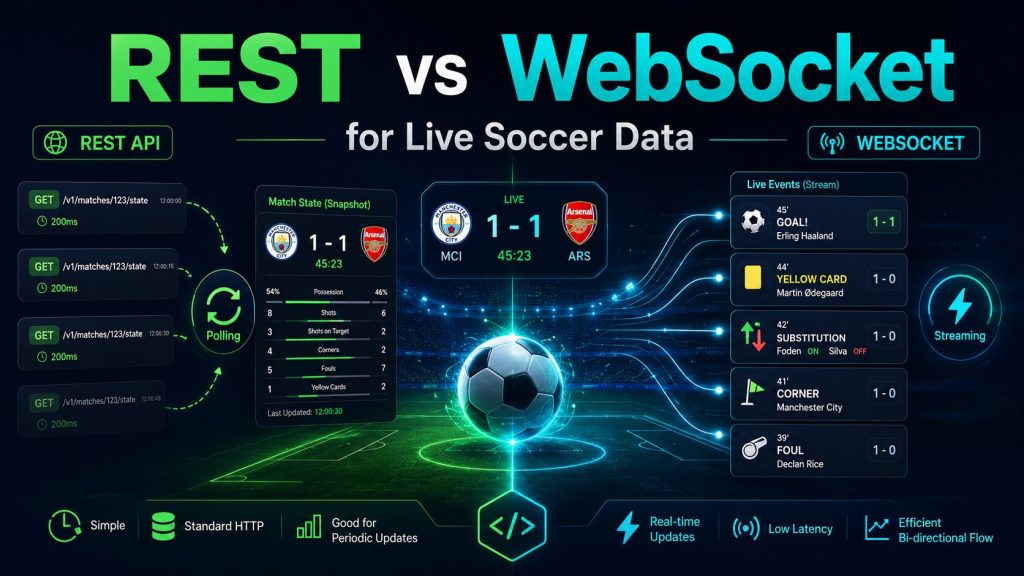
Live soccer applications need two different capabilities: a reliable way to load the complete current match state and a fast way to receive changes while the match is in progress. REST and WebSocket solve these problems differently, and the strongest architecture usually combines both rather than treating them as competing technologies.
This guide compares REST polling and WebSocket streaming for live soccer data. It explains latency, scalability, polling intervals, connection management, cost, caching, duplicate-event protection, recovery after disconnects and the recommended production architecture for score apps, fantasy platforms, media products, sportsbooks and analytics tools.
REST vs WebSocket: The Core Difference
REST uses a request-and-response model. The client asks for data, the server returns the current state and the connection ends. WebSocket keeps one persistent connection open so the server can send supported events when they occur.
| Feature | REST API | WebSocket API |
|---|---|---|
| Communication model | Client requests; server responds | Persistent connection with pushed events |
| Best for | Complete state, fixtures, results and history | Incremental live match changes |
| Connection | Short-lived HTTP requests | Long-lived WSS connection |
| Update discovery | Client polls to discover changes | Server sends supported changes |
| Failure recovery | Repeat the request | Reconnect, resubscribe and reconcile |
| Historical data | Well suited | Usually unnecessary |
What REST Is Best At
REST is the natural choice when the client needs a complete, queryable snapshot of soccer data.
- Competitions and seasons
- Upcoming fixtures
- Completed results
- League standings
- Team and player profiles
- Historical match data
- Initial live match state
- Recovery after a streaming interruption
Illustrative REST Request
GET /v1/soccer/matches/match_74021

Authorization: Bearer YOUR_API_KEY
Accept: application/json
Illustrative REST Response
{
  "data": {
    "match_id": "match_74021",
    "status": "live",
    "period": "second_half",
    "minute": 67,
    "injury_time": 0,
    "home_team": {
      "id": "team_18",
      "name": "North City",
      "score": 2
    },
    "away_team": {
      "id": "team_29",
      "name": "United Athletic",
      "score": 1
    },
    "updated_at": "2026-08-06T10:31:22Z"
  }
}
What WebSocket Is Best At
WebSocket is designed for event-driven applications that need updates while a match is live.
- Goals and disallowed goals
- Yellow and red cards
- VAR decisions
- Penalties
- Substitutions
- Match-status changes
- Injury-time updates
- Live statistics changes
- Scoreboard and notification updates
Illustrative WebSocket Event
{
  "event_id": "event_991827",
  "match_id": "match_74021",
  "type": "goal",
  "sequence": 184,
  "minute": 67,
  "team_id": "team_18",
  "player_id": "player_301",
  "score": {
    "home": 2,
    "away": 1
  },
  "created_at": "2026-08-06T10:31:22Z"
}
Polling vs Push
The practical difference between REST and WebSocket becomes clear when a match changes.
REST Polling Flow
1. Client requests the match state
2. Server returns the current score
3. Client waits for the polling interval
4. Client requests the same match again
5. Client compares the old and new responses
6. Client updates the interface if something changed
WebSocket Push Flow
1. Client opens a WebSocket connection
2. Client authenticates
3. Client subscribes to the selected match
4. Server sends a goal event
5. Client validates the event
6. Client updates the interface immediately
Latency: Which Is Faster?
WebSocket can remove the delay created by waiting for the next polling cycle. For example, if a client polls every 30 seconds, a goal could be discovered almost immediately or nearly 30 seconds later depending on when it occurred.
However, WebSocket does not guarantee a specific total latency. End-to-end delivery also depends on:
- The original data source
- Provider processing time
- Network distance and quality
- Your backend event processing
- Internal queues and caches
- The user’s connection
- Frontend rendering time
Scalability Comparison
| Scaling concern | REST polling | WebSocket streaming |
|---|---|---|
| Upstream requests | Can grow rapidly without caching | Fewer persistent upstream streams may serve many users |
| Server resources | CPU and request handling per poll | Memory and connection management |
| Traffic pattern | Repeated full or partial responses | Incremental event messages |
| Client complexity | Relatively simple | Requires heartbeats, retries and state recovery |
| Best scaling pattern | Shared backend cache | Shared ingestion plus internal broadcast |
Why Direct Client Polling Can Become Expensive
Suppose 10,000 users are watching the same match and every browser sends one request every 30 seconds. That design can create a large number of duplicate requests for the same data.
10,000 users
× 2 requests per minute
= 20,000 requests per minute

All users are asking for
the same match state.
A better design makes one or a small number of upstream requests through the backend, stores the result in a shared cache and serves the same current state to authorised users.
Recommended REST Scaling Architecture
Soccer REST API
       |
       v
Backend refresh worker
       |
       v
Shared match cache
       |
       +-- Web user 1
       +-- Web user 2
       +-- Mobile user 1
       +-- Internal service
       +-- Notification worker
Recommended WebSocket Scaling Architecture
Soccer WebSocket API
        |
        v
Live ingestion service
        |
        +-- Authentication
        +-- Event validation
        +-- Duplicate protection
        +-- Match-state updates
        |
        v
Internal message broker
        |
        +-- WebSocket gateway
        +-- Mobile push service
        +-- Fantasy scoring
        +-- Analytics pipeline
        +-- Persistent event store
The provider connection should normally be centralised instead of opening one upstream stream for every website visitor, unless the provider explicitly requires or supports that model.
Cost Comparison
There is no universal answer about which delivery method costs less. The result depends on the provider’s pricing model and your architecture.
| Cost factor | REST | WebSocket |
|---|---|---|
| Provider billing | May be based on requests or credits | May be based on connections, subscriptions or plan |
| Bandwidth | Repeated responses may contain unchanged data | Incremental messages can be smaller |
| Infrastructure | HTTP request and cache infrastructure | Persistent connection and message infrastructure |
| Development | Simpler implementation | More recovery and connection logic |
| Operational complexity | Lower for simple products | Higher for large real-time products |
Calculate the Complete Cost
Total live-data cost =
provider subscription
+ excess requests or connections
+ backend compute
+ cache or message broker
+ bandwidth
+ monitoring
+ engineering and maintenance
When REST Polling Is the Better Choice
REST polling may be sufficient when:
- The application has low or moderate traffic
- Updates do not need to appear immediately
- The provider does not offer streaming for the selected competition
- The product is an early prototype
- The integration team wants a simpler first implementation
- The application mainly displays fixtures, standings and results
- A shared backend cache can keep request volume controlled
When WebSocket Is the Better Choice
WebSocket is valuable when:
- Goal and card events must reach users quickly
- The application has many users following the same matches
- The interface contains a live event timeline
- Fantasy points must update during the match
- The product sends goal notifications
- A sportsbook or trading system needs live match state
- Repeated polling would create unnecessary upstream traffic
The Best Production Architecture: REST Plus WebSocket
REST and WebSocket should be assigned separate responsibilities.
Before connection:
- REST loads competitions and fixtures

When match opens:
- REST loads the complete match state

During the match:
- WebSocket delivers incremental events

After disconnect:
- REST reloads authoritative state
- WebSocket reconnects and resubscribes

At full time:
- REST retrieves the final result and statistics
- Stream subscription is closed
Step-by-Step Hybrid Workflow
- Request today’s fixtures through REST
- Store stable match, team and competition IDs
- Load the selected live match through REST
- Render the current score, minute and event timeline
- Open the WebSocket connection
- Authenticate using the confirmed method
- Subscribe to the selected match
- Validate every event ID and sequence
- Apply each unique event once
- Monitor heartbeats
- Reconnect after interruption
- Reload current state through REST
- Reconcile missed or corrected events
- Retrieve the final match record at full time
REST Polling Example in JavaScript
const matchId = 'match_74021';
let pollTimer;

async function loadMatch() {
  const response = await fetch(
    `/api/matches/${encodeURIComponent(matchId)}`
  );

  if (!response.ok) {
    throw new Error(`Match request failed: ${response.status}`);
  }

  const payload = await response.json();
  renderMatch(payload.data);
}

function startPolling() {
  stopPolling();

  pollTimer = setInterval(async () => {
    if (document.visibilityState !== 'visible') {
      return;
    }

    try {
      await loadMatch();
    } catch (error) {
      console.error(error);
    }
  }, 30000);
}

function stopPolling() {
  if (pollTimer) {
    clearInterval(pollTimer);
    pollTimer = undefined;
  }
}

loadMatch();
startPolling();
WebSocket Example in JavaScript
const matchId = 'match_74021';
let socket;
let reconnectAttempt = 0;
let reconnectTimer;

function connect() {
  socket = new WebSocket(
    'wss://stream.example.com/v1/soccer'
  );

  socket.addEventListener('open', () => {
    reconnectAttempt = 0;

    socket.send(JSON.stringify({
      action: 'authenticate',
      token: 'SHORT_LIVED_ACCESS_TOKEN'
    }));

    socket.send(JSON.stringify({
      action: 'subscribe',
      channel: 'match_events',
      match_ids: [matchId]
    }));
  });

  socket.addEventListener('message', message => {
    const event = JSON.parse(message.data);

    if (event.type === 'ping') {
      socket.send(JSON.stringify({
        type: 'pong',
        timestamp: event.timestamp
      }));

      return;
    }

    processEvent(event);
  });

  socket.addEventListener('close', scheduleReconnect);

  socket.addEventListener('error', () => {
    socket.close();
  });
}

function scheduleReconnect() {
  clearTimeout(reconnectTimer);

  const baseDelay = Math.min(
    1000 * Math.pow(2, reconnectAttempt),
    30000
  );

  const jitter = Math.floor(Math.random() * 1000);
  reconnectAttempt += 1;

  reconnectTimer = setTimeout(async () => {
    await reloadAuthoritativeMatchState();
    connect();
  }, baseDelay + jitter);
}

connect();
Heartbeats and Stale Connections
A socket can appear open while no messages are reaching the application. Heartbeats help detect this condition.
Illustrative Ping
{
  "type": "ping",
  "timestamp": "2026-08-06T10:31:30Z"
}
Illustrative Pong
{
  "type": "pong",
  "timestamp": "2026-08-06T10:31:30Z"
}
Heartbeat Rules
- Use the provider’s documented heartbeat interval
- Store the last received heartbeat time
- Mark the interface as stale after a confirmed timeout
- Close and reconnect unresponsive sessions
- Do not invent an interval before the production value is known
Duplicate-Event Protection
WebSocket events may be replayed after a reconnect. The application must not count the same goal, card or substitution twice.
processed_events

event_id          unique
match_id
sequence
event_type
provider_time
processed_at
payload_hash
Idempotent Processing Flow
1. Receive the event
2. Validate match_id and event_id
3. Check whether event_id already exists
4. Compare the event sequence
5. Start a database transaction
6. Insert the event
7. Update the stored match state
8. Commit the transaction
9. Broadcast the validated update
Out-of-Order Events and Sequence Gaps
Networks and distributed systems can occasionally deliver events later than expected. Sequence values can help detect missing or out-of-order events.
Last processed sequence: 184
Next event sequence: 186

Sequence 185 may be missing.

Recommended action:
1. Pause dependent updates
2. Request current match state through REST
3. Compare stored state with the response
4. Apply required corrections
5. Continue from the latest confirmed sequence
Corrections and VAR Decisions
Live soccer data can change after an event is first delivered. A goal may be disallowed after VAR, the scorer can be corrected or a card can be reassigned.
Correction Workflow
- Identify the original event
- Mark it as corrected, reversed or superseded
- Apply the replacement event
- Reload the current match state where needed
- Update the score and timeline
- Correct fantasy points and notifications
- Preserve an audit trail
Caching Strategy
| Data | Recommended approach |
|---|---|
| Competitions and teams | Long cache with periodic refresh |
| Upcoming fixtures | Moderate cache |
| Initial live match state | Short shared cache |
| Live events | Event-driven updates |
| Completed results | Long cache after final reconciliation |
Backend Broadcast Pattern
One backend can receive an upstream event and distribute it to many users.
async function handleUpstreamEvent(event) {
  const inserted = await saveUniqueEvent(event);

  if (!inserted) {
    return;
  }

  await updateCurrentMatchState(event);
  await publishToInternalBroker(event);
  await notifyConnectedClients(event);
}
This pattern centralises validation and prevents every frontend from implementing provider-specific event logic.
Security Differences
| Security concern | REST | WebSocket |
|---|---|---|
| Permanent API key | Keep on the backend | Keep on the backend |
| Browser access | Use a protected backend route | Use short-lived scoped tokens where supported |
| Transport | HTTPS | WSS |
| Authorisation | Validate each request | Validate connection and subscriptions |
| Abuse controls | Request rate limits | Connection and subscription limits |
Monitoring REST and WebSocket
REST Metrics
- Request count
- Success rate
- Response duration
- Rate-limit responses
- Cache hit rate
- Stale-cache age
WebSocket Metrics
- Active connections
- Authentication failures
- Subscription failures
- Heartbeat age
- Reconnect attempts
- Sequence gaps
- Duplicate events
- Event-processing duration
End-to-End Freshness Metrics
- Provider event timestamp
- Backend receipt timestamp
- Processing completion timestamp
- Frontend display timestamp
Recommended Architecture by Product Type
| Product | Recommended approach | Reason |
|---|---|---|
| Simple fixtures website | REST | Most content changes infrequently |
| Basic live-score prototype | REST polling with shared cache | Simpler first implementation |
| High-traffic live-score app | REST plus WebSocket | Complete state plus efficient live updates |
| Fantasy soccer platform | REST plus WebSocket | Line-ups and state plus live scoring events |
| Media match centre | REST plus WebSocket | Live timeline, score and statistics |
| Historical analytics dashboard | REST | Batch and historical queries dominate |
| Sportsbook or trading interface | REST plus WebSocket | Authoritative state and live event awareness |
Common REST Mistakes
Polling Every Match for Every User
Use one backend cache and share the response.
Polling Completed Matches
Reduce or stop frequent requests after full time.
Ignoring Rate Limits
Monitor quotas and handle 429 responses correctly.
Returning Provider Data Directly Everywhere
Normalise responses into your own stable application model.
Common WebSocket Mistakes
Using the Stream as the Only Source of Truth
Load complete state through REST and reconcile after interruption.
Ignoring Heartbeats
A connection can become stale without immediately closing.
Applying Duplicate Events
Store unique event IDs and process idempotently.
Reconnecting Without Backoff
Use capped exponential backoff with jitter.
Exposing Permanent Credentials in the Browser
Use protected backend connections or short-lived scoped tokens where supported.
REST vs WebSocket FAQs
Is WebSocket always faster than REST?
WebSocket can remove polling delay, but total delivery time depends on data sourcing, processing, networks and application architecture.
Do I still need REST when using WebSocket?
Yes. REST is useful for initial state, fixtures, history and recovery after disconnects.
Can REST handle live soccer scores?
Yes. Controlled polling can support live scores, especially for smaller products, provided quotas and caching are managed correctly.
How often should I poll a live match?
Follow the provider’s documented rate limits and update guidance. Use a shared backend cache and reduce requests when the match is not live.
How do I recover missed WebSocket events?
Reload the authoritative match state through REST, compare sequence values and then resubscribe.
Which method is cheaper?
It depends on provider pricing, traffic, caching, connection limits and your infrastructure. Calculate the complete production cost.
Can I use WebSocket directly in the browser?
Only when the authentication design supports safe client access. Permanent private credentials should remain on the backend.
What is the best architecture for a live soccer app?
Use REST for complete state and WebSocket for incremental live events, with shared caching, duplicate protection, heartbeats and reconnection.
Build a Reliable Real-Time Soccer Architecture
Use REST to load and recover complete match state, then use WebSocket to receive supported goals, cards, substitutions, VAR decisions and status changes as they occur.
Build Cricket Products With Reliable API Data
Access live scores, fixtures, ball-by-ball updates, statistics, odds, predictions and historical cricket data through one developer-friendly API.
Get API Access